
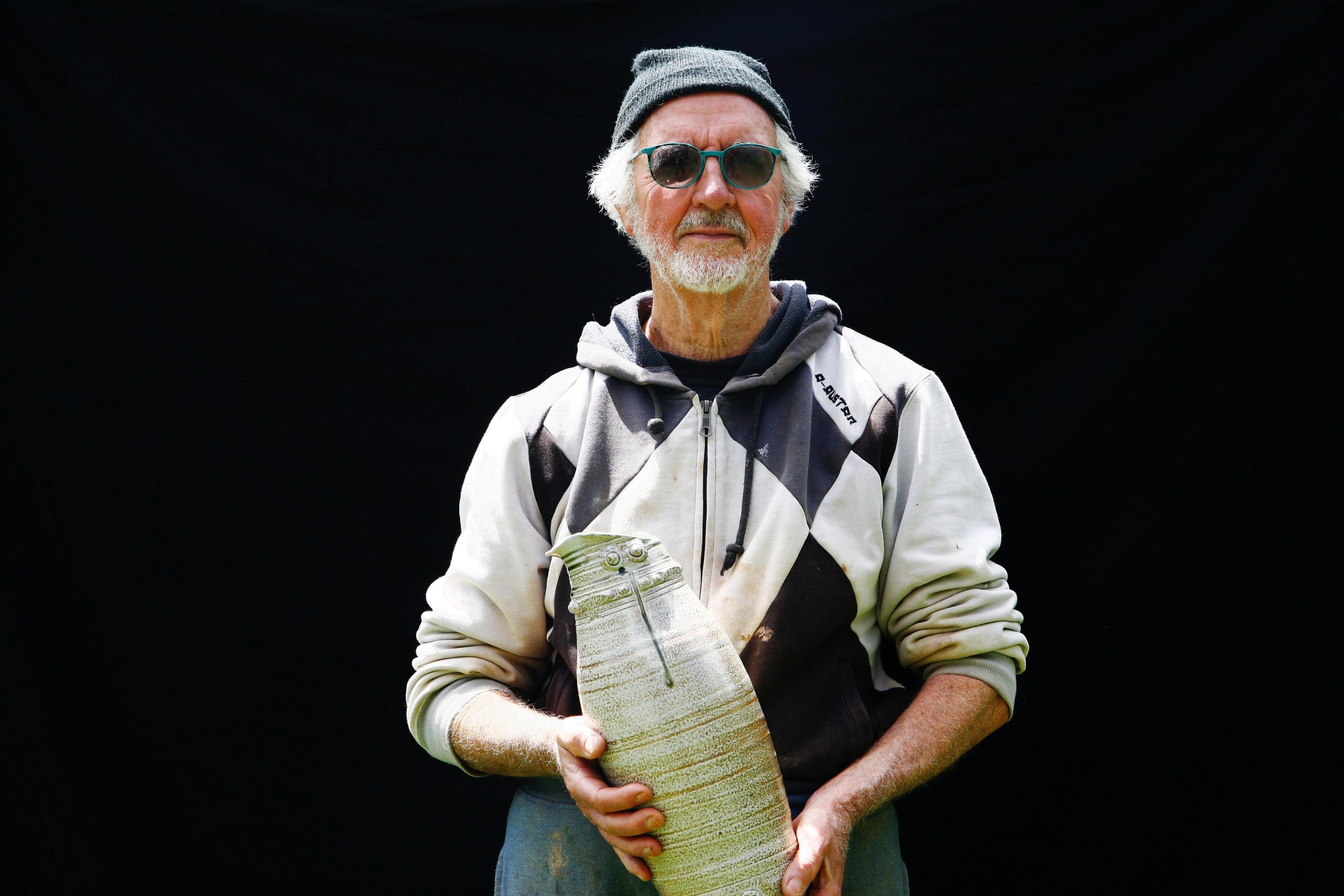
The remains of a conversation with Lindsay Scott,
a South African potter who lives and works in Howick -KZN.
LISTEN ON SPOTIFY
I’m on the road to Howick. My car is loaded with art. Paintings and objects. I take the 6 hour drive there to deliver these valuable pieces because I want to support a friend’s dream.
The dream is to create a hub for artists in Howick. I am sceptical. About 14 years ago I was in Howick and in my memory the only thing that was there were beautiful dark green hills and a gloomy cabin in the woods. I’m curious how you can start something for artists in a place like that?
Because I want to hear from different artists and have conversations with them, I want to take the opportunity to meet a master potter in this place that is so far from Johannesburg. KwaZulu Natal holds a long and rich history in pottery-making. My host has arranged a visit with 82 year old potter Lindsay Scott. Lindsay Scott studied psychology in America and perfected his ceramics skills at Oregon Stoneware Pottery. He returned in 1974 to South Africa and pursued his passion for throwing bowls and became an internationally recognized master ceramicist. He based himself in Hillford, KwaZulu Natal. He was one of the founders of the popular Midlands Meander. An initiative to get publicity for local artists in the area.
But communication is not easy when there is so much physical distance between people. I did not have the opportunity to ask in advance for a book or a movie to base our conversation on. I will visit the master potter in his studio space, not in mine. These small deviations from my usual set up make me curious: what will happen in a conversation when I do it like this?
It will be a long drive. The weather doesn’t look all that great, and I’m worried I will arrive late and will have to drive in rain on muddy and windy roads at the end of my trip. But the rain and even hail meets me much earlier, it is already before the infamous Van Reenen pass that I’m hit by rain, hail and wind. I can’t see where I drive, I’m scared so I go off the highway and drive into a little town, called Warden. It has a church tower: I’ve passed it so many times. It looks like a picturesque village from the highway. But there is nothing picturesque about this town. It’s just lots of old derelict houses, unkept gardens and roads that are filled with potholes. Luckily the minute I park at the local fuel garage the hail stops. I decide to immediately hit the road to Harrismith again. That’s where I want to be to take a break and decide if I can continue.
I’m lucky. At Harrismith the rain has turned into a slight drizzle, so I take a short break, get a fluorescent yellow poppyseed muffin, a good cup of coffee and drive off. I manage to pass Van Reenen while the weather is calm. After another 3 hours’ drive during dry but still threatening weather, I finally leave the highway. The farm I’m going to stay at is only 20 minutes away from the offramp. I’m almost there, I just have to find the place. It’s not far, but to find your way on dirt roads amongst hills you don’t know is a bit daunting albeit beautiful. Two minutes away from the Highway and I am in the middle of a space filled with open fields and trees and hills; I feel as if I’m in the wild. I’m surrounded by nature and people are scarce. This canvas that I have now entered is so different then the one I’m used to at home. It feels as if I’m doing a balancing act in something new. And there it is, perched on a hill looking out into the sky, three neat rectangular one storey buildings. The farm that will be my stay over for the next two nights.
My hosts are a young couple. Both are artists, Ben is a game designer and Morgan is a curator and fine artist. The art I’ve brought is for her to use in a space at the Old Mushroom farm in Howick. I get a cup of tea while we wait for the light rain drizzle to stop and we immediately find ourselves talking about lots of different things. When the rain clears we unload the art pieces from my car and carry them into their home.
The next day Morgan drives me to Lindsay Scott, the artist she wants me to meet.
We pass through small communities and then through a dark, desolate, underground passage. It gives me a haunted feeling – I wonder why.
I ask her: “are you ever scared to drive here?”
“No”, Morgan says. “These people are kind and caring. They are poor, but the farmers leave potatoes – the ones that can’t be sold – on the side of the road for them to pick up.”
The picture of hostile people from KZN imprinted on my mind by the media is contradicted by what I see and what she tells me.
She drives us into a young forest, where the trees are thin, not yet tall, all bent in the same direction. Morgan explains it’s from a very unusual heavy snowfall a month ago.
We stop at a horseshoe-shaped house that is nestled among the trees. there is barely any light. In an open space I see a huge dark blue abstract sculpture. A man stands in the garden. He looks lonely to me. He carries a small dog. He wears blue plastic boots and light blue jogging pants that are covered with white spots, clay, I think. His triangled sweater is smudged too. He has a long face and a grey beard. He wears a blue beanie, white hair comes out on both sides above his cheeks. I see dark tinted glasses. I can hardly see his eyes. We greet each other and he walks into the house. We follow. I see his gallery. We look at plates and small vessels. He immediately begins explaining how he made them. I hear terms like carbon dioxide, throw a bowl, salt kiln, electrical oven and others. I am lost. I tell him I don’t know anything about the whole process. He laughs. He shows me his other workplaces. I see pots, in a beautiful dark mossy green colour. “No, they don’t stay that colour.” He tells me. We walk through a dark narrow hallway to the backyard. I follow him through a door onto a stoep filled with many objects- old chairs, plastic paint buckets, brooms, plastic sheets. They seem random at first sight, yet, I don’t think they have lost their function in reality. I feel I’m on a sort of threshold. Like there’s a definite separation between two worlds. At the back I feel a space – the house- that is made by and for humans, and in front of me is a world ruled by nature. I see a small lake, tall green trees. The surface moves down and up. The hill is covered with bushes and tall trees. I feel as if the hill and it’s trees, hug us.
I tell Lindsay I am interested in artists and why they make what they make. He turns around to me, leans against a wooden pole, and says: “that is easy, because of the damage and the hunger”.
“The damage and the hunger?” I ask, “what do you mean?”.
“Well”, he says, “of course there is the wound I want to heal and I need food on the table. I need to make money too”.
I am taken aback by this answer. It felt so honest, pure, I wanted to keep that sentence as he said. I need a pause but Lindsay keeps talking, he says, “don’t we all have wounds to heal?”
“Yes”, I say “I think so too, yet we don’t all make things as a way of healing…?”.
This time, Lindsay takes in my answer: did he realise something about himself there and then? Maybe?
We move on to other spaces.
He shows me several kilns, some are broken. Then we go to what looks like a farm shed, it is made of wattle and mud. It’s a big open space, the light comes in through holes in the wall and I see bags of sand. A few machines and tables.
Here, Lindsey’s staff make decorative tiles for commercial use – these tiles make him money. We go outside again and I’m shown a storage room where big piles of stones are sorted in three colours. I’m told that the black stones will turn whitish in the oven, the grey stones will turn like a beige and the grey stones with the yellow stripe, will turn into a terracotta red.
After seeing all the workplaces we walk back inside. We settle into the couches and chairs in the gallery. It is a light and pleasant space. A big red painting towers over us. I ask Lindsay: “what is the story of that painting..?” Lindsay responds: “Ah yes this is an artwork left to me by someone who used to rent a place at his property. Too big to travel, the painting stayed”.
The gloomy painting is a contrast to the smooth and pleasant coloured vessels that are on display. I am intrigued as I think what would the space look like without this dark image?
We sit down. Lindsay sits in a big comfy white linen armchair and I’m on a wide, deep and soft couch. I get out two books from my bag. One is a thesis of an Australian performer about touch and performance and the other is the latest book about South African ceramists called Clay Formes. I’ve read both books and want to share some of my responses to these books with the artist. The books made me think about the process of art making and because I didn’t get a chance to prepare a shared experience with Lindsay Scott, I want to try to base our conversation on statements that piqued my curiosity from these two books. This means I have to first read to Lindsay the parts of the books that interested me.
I read a journal entry from Angela Mary Clarke’s thesis ‘Wild Life’. She is a
performance artist. She researched how whole bodied awareness while you make something can influence your performance in a positive way. She concluded that if you pay attention to what happens in your body while you make something, this awareness can enhance your performance. She noticed how the awareness of her hands, the touch of her fingers, seemed to enhance her performance. I believe this could be the same as making bowls, or throwing them as Lindsay calls it. His art is fully made with the hands: he touches the clay continuously while he makes a pot. So I ask Lindsay:
“Do you recognise touch when you make art; how does your body feel, what does it do for your artwork?”
“No” Lindsay says, “I don’t recognise that my making pots is a full body experience. I mainly make with my hands. After I’ve made something I’ll look at it and if I like it, if there is beauty in it, I keep it, otherwise, I’ll toss it away”.
This is not the answer I was looking for, I can not imagine making a pot occurs with only the hands. While I realise this, my mind clings to the word beauty that Lindsay used.
“Beauty, do you look for beauty? What is beauty for you?”, I ask.
“When there is power and a force”, Lindsay says. “And terror.”
I understand the power and the force, but terror? Does beauty have to hold a terror?
This time, again there is no answer. We sort of just lock in looks and the space in between us stays quiet.
I pick up the book Clay Formes. Lindsay shows interest in this book. He leans towards me when I hold up this book in the air and his face lights up. I want to hear what he has to say about a specific passage in the introduction by Ashraf Jamal, a well-known South African art critic. I read to him the following passage:
When regarding forms made of clay, never assume that they are static. And remember that the things we have made, our houses and urns, our vessels and idols, our votives and prayers, our laws and myths – all made of clay – are the fallout, leftovers, remainders – “debris” – of an ancient time, long before fallible human invention.
I’m very interested in what Lindsay thinks of the word ‘leftovers’?
I ask:
“Is the current form of art, made from leftovers from the ancestors? Isn’t that word derogative? Shouldn’t we be talking about what remains and isn’t what makes us human the art we create ourselves? The new thing I mean?”
Lindsay responds: “No everything we make is made from the old. We can not make something new”. It is an answer I understand and resist or grapple with at the same time because for me art is never a left-over but always intended as a main course. For me it is to make new meaning again and again, a new highlight, a new thing to say.
I ask Lindsay, one last thing. It is from the chapter in Clay Formes about the artist Fani Madoda. Fani Madoda is a South African master ceramist from Cape Town. His work is inspired by his African heritage.
I read to him :
Fani’s vessels speak for themselves, carried forwards by the people before them. A continuity of form, each vessel echoes the hands that have metaphorically shaped it. Fani’s practice is future-oriented running, and it is rooted in the room of the predecessors: Simon Masilo, Nic Sithole, Nesta Nala, Jabulile Nala – long ceramic continuities of smoke-firing, burnishing, coiling, and now the space to uncoil this ancient thread.
My question is: “When they say the roots… what do they mean by that? What are exactly the roots of Fani Madoda? Do you know?
Lindsay is quick to answer me: “Yes, those are the traditional beer pots made in KwaZuluNatal.”
This seems like a simple answer to me. I feel stupid for not knowing this.
But sometimes it is the simple things in the story, that make the difference between understanding and feeling lost. Yet, I cannot let the feeling go that there must be more to the roots. At least I know I want to know more.
Morgan and I pack up our things and we say goodbye to Lindsey. Before we go back to the farm, Morgan shows me the place where her studio will be: The Old Mushroom Farm. It is a huge complex with many different places for artists and retailers to work and sell. It has an organic garden, a space for stand-up poetry and in the near future a place for a foundation where curators and artists can come together. I am blown away by the modern look and the professional set up of short and long term accommodation. Nothing there resembles a lonely and dark cabin in the woods.
The next morning on my way back to the big city I have good weather, yet, it’s a difficult drive as I have to pass truck after truck. I see yellow rondavels with bright red roofs in the open highveld, I am going back to the big city. I feel fulfilled, the art I brought with me is in a place that does not resemble a dark and lonely cabin in the woods. And I had a conversation with someone I did not know that was meaningful to me in many ways. It was different, there were more gaps in our conversations: silences; thinking moments. But they were valuable, nevertheless, or maybe even more so…
I do believe I skipped a beat in my introduction about what I want to discover in these conversations. If you’ve listened to my other episodes you will know that I am inspired by some ideas of the philosopher Heidegger. It is to look at the work of artists and see if I can discover what their work says about our society. If I look at this conversation with an artist who lives far from me and who lives in a totally different world; one much closer to nature, I have observed that despite the physical distance and despite not knowing each other at all we can find mutual interests and have conversations based on curiosity about the other.
And what does his work tell me about the society we live in? That is an easy one for me, and that is that – beauty – is necessary. Whether we link it with terror or not. No beauty? It will be tossed away…
What I take with me to my home in the city, is the image of 82 year old master ceramicist Lindsay Scott in his backyard leaning against a wooden pole. The backdrop to this image is nature: a spring green forest with a little lake and a sky covered in blue and grey. The words he spoke resonate: “the damage and the hunger, the wound that needs to heal.” And “beauty and terror”.
Beauty.
I could not resist buying a bowl from Lindsey. It’s in our living room, just casually on the floor. When I look at it I feel something healed.