
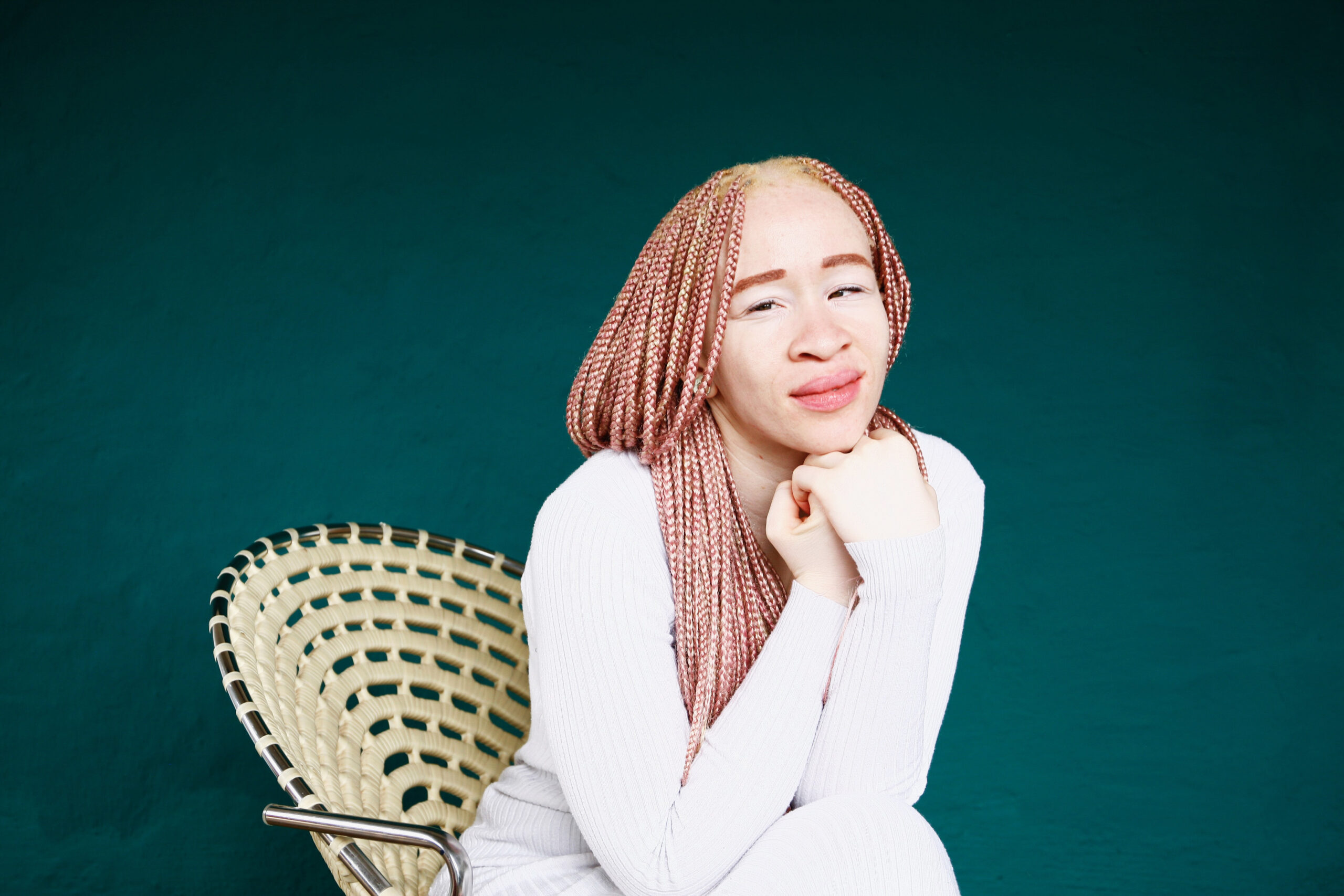
The remains of a conversation with South African artist Athenkosi Kwinana.
Johannesburg, 9th of February 2024.
This part of our journey, reader, is about storytelling and hence, you, we, need to listen. Young South African artist Athenkosi Kwinana has albinism. Her art works are often large self – portraits, yet made with meticulous detail. Athenkosi draws herself literally up-close.
I had asked Athenkosi to give me something she values, to experience. She invited me to listen to an ASMR video. She explained to me she listens to this while she works on an artwork. I was curious, I had never heard of it, so I took some time at home and sat behind my desk and I clicked on the link she had sent me.
I heard GrrSSSPTT grrrrrtssabgkiiop GrSSSPTTTTt and I saw a man’s scalp with white dots and a woman’s hand with a pair of tweezers, picking at the white dots. I heard GRRSSSTPPTTT and I saw the hand move towards the white dots. My stomach turned, this looked disgusting. I didn’t want to look. I didn’t understand anything the woman said. I just heard fragments of vowels and sounds. I got annoyed; I couldn’t hear her. My hearing disability blocked the entrance to this experience. I searched for subtitles, but they were not there. I felt panic and irritation, because how could I have a conversation with Athenkosi, if I couldn’t undergo this?
The video Athenkosi had sent me is from a woman from Kenya who records herself telling stories from her childhood to her Tsjech husband, while she nit-picks his hair. Athenkosi had warned me, that if I have a soft stomach, I might not want to watch it. What I saw, I did find strange and indeed my stomach did turn. However as I had understood Athenkosi, it is about listening to the stories, so I focused on the story the woman tells. But I couldn’t hear it, I felt anger. I was cross at my disability. Yet, I stopped this trail of thoughts and I brushed my anger aside. I looked elsewhere. I looked for more information about ASMR; could I find images maybe?
I wanted to find in images that which I couldn’t hear. Which words were there to read about ASMR? Words are images, I would understand those. Could I find something to see?
I discovered ASMR is not about the stories that are being told, but it’s about the sound effect of the soft voice, the whisper. The abbreviation stands for: Autonomous Sensory Meridian Response. That is the experience I had to ‘feel’. I tried again. I hid the images of the video and only listened to the vowels and softness, the rhythm of the voice.
I listened and I worked on some light tasks. A very pleasant feeling ran through my whole back, it reached my head. It somehow pulsed pleasant waves of feelings to the outside of my body, my skin. I thought I noticed a nerve inside my spine that vibrated soft pulses: soft high notes. I became calm and worked through some work tasks with a lightness that was new to me. My curiosity was sparked and I looked forward to hear more from Athenkosi about her experience with ASMR.
A week later I was on my way to my conversation appointment and my senses were on high alert. I felt I was driving, I saw more, I heard more.
It was as if a rope pulled my chest towards the place and moment in time where I was going to meet Athenkosi Kwinana. I was even more aware of my body than I normally was, and I was curious, maybe this had something to do with my encounter with ASMR.
This experience had changed the state of my body while I listened to it.
The conversation day started covered in clouds and the air had a brush of coolness. Yet, we were in a heatwave so I cherished the short cool moment. When I got close to my studio, I noticed warning lights from an opponent on the road. The next thing I saw was yellow tape on the road and two police cars. Something was wrong and I could not go further. The yellow tape and the police car evoked images in my mind; the possibility of an attacked body, a murdered person. I thought of Athenkosi who must live with a constant fear of violent attacks on her own white, coloured body as in South Africa an African person with a white skin is still treated often as an object to be ‘acquired’ for superstitious rituals. The yellow tape aroused in me a fear. I drove on, I had to turn, and make a detour to arrive at my destination. The detour was easy, I was quickly back on known territory. And the yellow tape disappeared from my mind.
Before I turned the last corner to my parking destination, I saw a woman dressed in black, with a red backpack on her back and a fur hat with cow prints on her head. I saw she wanted to cross the street and I stopped my car. I gave time and space for her to cross the street. I saw the warm hat on a hot day.
After I parked I went to the coffee shop. Athenkosi was early and had already ordered her coffee. I also made my order and soon we were on our way to my room.
Athenkosi I remember you, I see you as if in a picture. An African woman with white skin, your arms are bare, you wear a tank top. Your hair is long, in braids and it is pink. You wear thick glasses with a black defined brim. Your one eye moves often from left to right. Your other looks steadily at me. You tell me many stories. You answer each question with a story. You’ve told me the ASMR video calms you, now that I have experienced ASMR and met you, I see that calmness. Yet, I also see a lightness of being that I link with the tingling sensation I experienced with the whispers I heard.
When I looked back at our time together, I realized it is the stories you told me that settled in my mind. It’s like your history unfolded in me.
This history is accompanied by defined images of you. Besides images I see snaps of sentences you said and I wrote down. It’s as if I see what you said. I have shaped these fragments, images and stories you told me into an account. I think it’s the story I heard you tell me. They are for me the remains of our conversation.
Athenkosi, I heard you tell me the following:
Athenkosi Kwinana is a girl born in South Africa, in a tiny little place called Corana in the Eastern Cape. It is actually in Mthatha, which is the main city of the district Nelson Mandela grew up in. She has a white skin, and yellow hair, she is raised by her family as a normal child. She wears a big sun hat and puts on lots of lotion. Her school is a normal mainstream school as her mum insists she, Athenkosi, has a normal routine. She is close to her family and she can tell many stories about her family. Her culture is Xhosa, a way of living that embraces the thought that every small thing you do matters. Every action needs to be done with the utmost care, like cooking, cleaning, and telling a story.
Storytelling is a defining part of her Xhosa culture. She learns many a thing by listening to stories from her mum and grandmom. Everything around her is a story. A full story. Her gran dramatizes every story she wants her to know. If someone falls, the story contains the exact look of the stoep and two hands in the air and eyes bulging from fear. What needs to be told is never told with one line, every part of the story is described in full. One famous story is about her aunt, who is always fashionable late. Even the day when Nelson Mandela was in town to give toys to the children of the village he grew up in. Her aunt was supposed to bring her to Nelson Mandela, but she arrived so late that Nelson Mandela had ran out of toys. After a long wait in a long line on a hot day, a security person told them they couldn’t meet Mr. Mandela as he had ran out of toys. This story is for Athenkosi an opportunity to laugh out loud.
Because of her bad eye sight she needs to stay very close to things to be able to see them, for instance she stands in front of the small Panasonic tv her family owns and she thus blocks the view for her siblings. Her mother helps her siblings, she moves her away from the TV and she gives her paper from a red box and a multi coloured pen. Athenkosi starts to draw. One day she is outside and she plays, she hears her neighbour, a boy about her age, he sings a song it seems to rise from his tummy, loud and clear. The song is about her. The words slap her in her face. Her mother stands behind her, she puts her hands on her shoulder, together, they walk back inside the house. They never speak about this again.
She travels often with her mother. They are on the road and they see houses that inspire them. “What would it be for us to live there?” Her mother asks, they drive on and they play a game. They fill in the house with furniture and curtains, every little plate and table and chair is imagined and described in full detail. The pillows on the couch are purple and they have pineapples pictured on them. Daydreaming becomes a habit. Then at high school Athenkosi sees work from Salvador Dali and her own imaginings become a replacement for pain.
Her family fights for social justice and so, as Athenkosi grows up she too wishes to pursue a career where social justice plays a role. Unfortunately she does not have enough points to enter the school and she begins to worry what to do. Around this time it becomes clear to her that she is not a normal child. People see her as ‘different’, she encounters beliefs that make her vulnerable to physical attacks to her body, because of the colour of her skin. This maturing girl no longer feels normal and she starts to switch her self and her body off.
Then someone looks at her art and tells her she can fight for social injustice with art. And it is then and there that she realizes that she want to study art. There are still problems, though, essays need to be written and how can she fill an essay with ten thousand words about a subject? Again it is someone else who gives the idea. She can write about albinism, write about her life as an African woman, with the condition that gives her a white skin and bad eye sight.
Now she is no longer unsure what to do. She is still anxious, but she doesn’t switch off anymore. She knows how to calm herself as her sister told her about a technique called ASMR . To listen to a voice, a whisper, to hear stories. When she listens to a woman from Kenya who tells stories to her husband, while nit picking his hair, she is transported back into the past where she was calmed by her mother, when she did her hair. When her mother told her stories.
Now she makes art and she starts to smile more.
She travels on her own and enters different places, encounters different people. Hears different voices. She reads Frantz Fanon, Black skin, white mask, a writer who sat down and observed society to its core. The book creates awareness in her of people living inside a society, a group, a community. She has left her safe home and enters a society that behaves different. She enters spaces that hold other words; she hears those words and sentences. She hears new words, weird commentary about her, questions about her body that are strange and private and offensive are spoken, mainly by black men and black women. “She is a white-black woman”, she hears someone say here in Johannesburg. She does not feel safe in this black community, she cannot belong here. She makes a decision to avoid groups of people that are black. She will go other places, alone. She is not black and she is not white, she is an exception.
To make art about a social issue that applies to yourself is hard for her, it means she is her own subject. It is painful, yet she also enjoys it. She can fight for something, like Zanele Muholi and Diane Victor do. She likes the work Diane Victor made of baby Thabang who was raped, despite its graphicness. She thinks it’s in your face and that creates this urgency. It wakes people up. And that’s what she wants to do: to wake people up in South Africa.
Athenkosi starts to make art that is received well and she gets noticed in the art world. She earns an art-in residence program and she goes to a different country: Cuba. She experiences life as a white skinned African woman in Cuba and she realizes there she is ‘normal’, there is no ‘otherness’ in Cuba. She relaxes her body. When she sits around a table with some new made friends and shares her story with them, they laugh at her and tell her she does not have to worry as in Cuba she will not be chopped up because of the colour of her skin. Athenkosi learns there are places in this world where her skin is not a topic of concern.
Now she wants to reimagine how the albinic body is seen in South Africa where she perceives there is a general fixation on skin colour and normality. Often the albinic body is portrayed as demonic or fairy like and she wants to show that it is normal. She wants to bring the values and beliefs from other developed countries to South Africa.
She has laid the foundation of her artwork with drawings of herself, she now wants to move on and draw others, other people with albinism. The daily exposure to detailed stories from her Xhosa culture in her childhood have made detail a necessary ingredient for her own stories. She will sit close with others, so she can see them, and she can portray them. And while she does that, she will smile for the making of art is healing for her. She compares it with washing clothes by hand. She cleans not by destroying but by removing that which cannot stay. She brings dignity to her body. When she makes art it makes her feel as if she’s a kid in a cupcake store.
Often when she looks back after an art make session she laughs out loud in wonder and says: “Did I make this?”
And I say: “Yes, you did”.
And for me, I think you did more. As still today I hear your voice and the soft delicate yet firm tone you used to talk to me.
To hear you tell me you decided to stay away and avoid groups of people that are your own people, made my body freeze up. People do not easily tolerate the exception. You said this very casually; almost a-matter-of-fact. You are a visual artist and you told me your story.
And what is still with me is the thought that your tellings are detailed, storied, descriptions of a painful reality and your images are detailed storied imaginations of a possibility. And a thought crossed my mind: Could you also tell us detailed imaginings of a possibility?