
The remains of a conversation with South African artist
Odette Graskie
Johannesburg, Victoria yards – May 2023.
Reader, each story has a beginning, a middle and an end. This is the beginning of a beginning. I drive on an autumn day in Joburg through the modern suburb of Parkhurst. I see billboards backed by the gold of the trees. And the words on one of them sparks a thought. I feel my chest and my mind moves – it gives me a thought. I see where I am, in my car that passes bling shops, over potholes through a tunnel of bright red and golden yellow, and the blue of the sky, a long forgotten trash bag marks the beginning of the end of the tunnel. The word artist flashes by. The word triggers the thought that artists do not do nothing, they make something out of nothing. I think of Heideggers approach to art, I recently studied his article “The Origin of the Work of art” in relation to South African artist Odette Graskie. He thinks we can understand our community when we look at the work of artists. Their work reveals a truth that is hidden from our daily lives.
Our world is complicated, there is so much going on. Especially in Johannesburg, so much contrast, so much sheer poverty, so much opportunity lying around wasted.
If the work of art, and here I’m following Heideggers train of thought, is a revealing of something that is going on in society I could find out more if I study artists, if I look at their motivation for making things.
To understand people or things is to lay bare tracks and traces. Often it is digging in the past. But what about digging in the present? I feel the urge to ask questions to artists, have a conversation. The phrase ‘lost in translation’, comes up in my mind. I feel sorrow when I think of that phrase. I believe it focuses on the loss in a conversation. My mind is on an alert and thinks the opposite. Could I turn. That phrase around and focus on the remains of a conversation, as the focus of my venture? My fascination is with what remains, not with what was lost. I am excited. I think while I swirl to the left to avoid a big sinkhole. I can’t see the blue sky anymore, the trees are dense here and hang over the road. I focus and think at the same time.
I see myself talk with artists to uncover their tracks. Use the work of artists to find out more about the signs of our time.
I leave the autumn tunnel in my mind behind, and I enter the middle start of this story. I start my conversation adventure. I ask South African artist Odette Graskie. I know Odette Graskie and her work via my Heidegger study and I remember we had a conversation that inspired me.
I want the location to be a suitable space for our conversation. An intimate and separate space from the rest of the world. And the chairs need to be comfortable and since I also have a fondness for small and quirky chairs, I dress the room up with those. I believe conversations are much more interesting if they are based on shared experiences. My curiosity lies with having a conversation with an artist about books or movies, or maybe even gallery visits or something else, and bounce of the thoughts and feelings that were experienced. I’m curious to know what has inspired Odette recently.
Odette agrees to join me on a shared experience adventure, and she gives me an experience trail to follow.
She gives me hints of books from the past, like The Lord of the Rings and poems from Emily Dickenson, but I leave them alone. And I pick up the hints of a gallery visit and poets that are new to me. I chase them. I visit the Jack Ginsburg centre for Book Arts at WITS. I read New names for lost things by Noor Unnahar and Let the world have you written by Mikko Harvey.
All three of these experiences are new to me. All three experiences become an addition to my daily rhythm.
The small light room where we have our conversation is situated in the middle of the Johannesburg inner city. A place you can only reach if you pass through long dirty, potholed and windy roads with tall and high and unkept trees. The shadows of these trees are present while the sun tries to leave its trace wherever it can. When she finds a place to land you see fires by the road, fallen houses, doorways to small rooms that have not seen light in many years.
The buildings that hold the location of our conversation have been cleared from dirt and shadows. The pathways to different rooms are accompanied by vegetables and small trees and flowered bushes. Here and there you see a sunflower. In that building labyrinth we have our conversation.
I will end this story whith what remains with me of our conversation. With what I am left with. It is a push back off all of the noise and energy waves of the big wide world to a far away background. A creation of a time in a place only for a few things that we choose to talk about. We literally sat in a quiet corner in the middle of a big buzzing city and allowed our selves to spend precious time talking about gallery visits, and poetry.
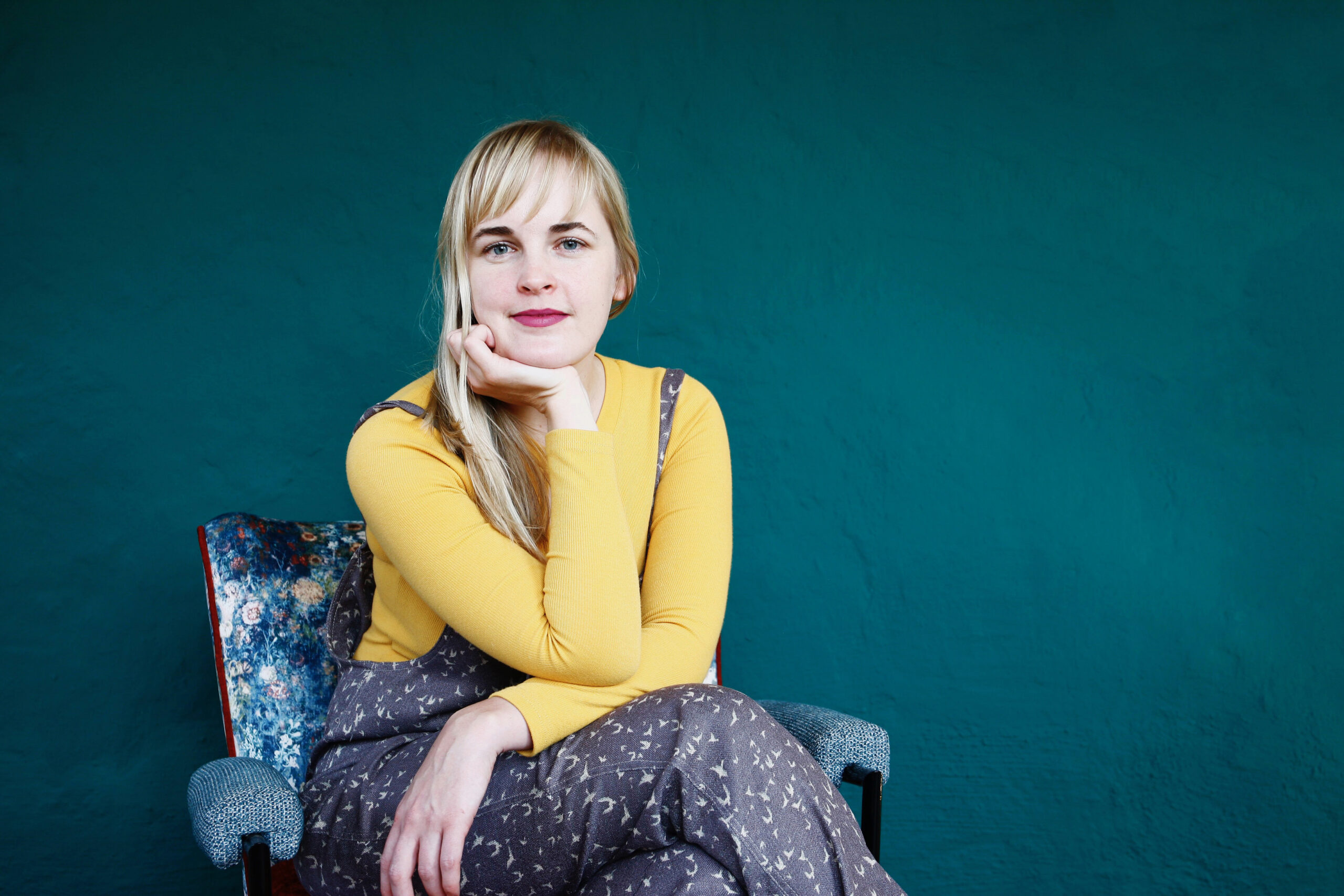
An image exists in my mind of you holding up one of your artworks -one that I specifically like – while you walk toward me. The artwork is a gift and I cherish it while it moves gently on my left while I type. Things that move lift me up. The noses and eyes and many lips of your artwork are near me. I am surrounded by people when I type these remains. I see us in the chairs, you in the flower chair and me in the mama Zulu chair. We sit across each other and we talk, read and listen. Your dream of having your art book become part of the Jack Ginsburg collection materialises in front of me. You felt inspired and welcome while you visited the collection. Yet, I had had a totally different experience. I had to ask permission if I could enter the gallery, I was told it was only open via appointment. In the end I was allowed to have a look but I did not feel welcome. We both regret the inaccessibility of the collection to me, to someone other as an artist. You express your gratitude for libraries and you share the big role it has played in your life. The white walled room with the two chairs is occupied with our concern about the state of libraries in Johannesburg. You fill the space with your wish for more third spaces in Africa. Those strange yet, needed places that are a room for people to be in, in between work and home. These spaces are rare, like good libraries. They hardly exist in Africa. You speak about your dream of creating your own library. I share that dream and I realise in that room that we don’t only have a conversation about shared experiences, but about a shared dream too. We dream of an inspiring library in Johannesburg. We put a ribbon on that dream and we box it.
I see us, two white young women open our poetry books. We are eager. I can’t remember which poet we first talk about. Time has merged the two poets into an explosion of thoughts and words and smiles. I remember we talk about blueberries that melt on a tongue, about how parts of our bodies, different functions of our bodies are named as animals, like rabbits or owls. We identified a father that is both a very loved person and someone who leaves difficult feelings behind. We both especially love the title of Noor Unnahars poetry album – New names for lost things.
How beautiful can you make a sentence? I remember driving back after our talk and think “new concepts for old things”. I texted you I would use that in my text. And here you have it.
Again I can’t remember what sparks it, but you mention, the experience of hearing and seeing yourself as your mother. The doubling up of your mother in yourself. The realization we are a connecting line with our family. You told me the pain of the passing of your grandmother had sparked you into making a drawing of birds, I think you said starlings. When you see that drawing you are transported back to that moment of loss. Grief. While I listen to you telling about the grief and the birds, I see myself sit at my long table at home write a story about a rabbit with a red eye. An evil eye. For me that rabbit story became a sort of storage box of experienced pain. It was acknowledged but because it was written, it could be put away in a special box and I could move on. I was back on the road again. It is how art can work. The image of your drawing of birds which you keep in a drawer has stayed with me all this time. It is one of the images I see when I think of our conversation. Birds flying away out of a drawer.
What is now left with me, after we both sat in those two very different chairs in that small room in the middle of Johannesburg, are very clear images. The remains of our conversation are crushed blueberries, connecting lines between family members, birds flying away from a drawer, owls and rabbits, dream libraries in Johannesburg and an image of time created by the push back of the noise of the world. When I think of that in connection to your art work, your faces and places, I can’t help but see the question – could you draw a moment in time that pushes back the noise of the world?
By Christi Sa